

The Sacred Pause
A return to presence, that is already, always here


Last Tuesday, my client Myla sat at her desk surrounded by half-finished projects, open tabs, and the mounting tension of a day spent sprinting without rest. She hadn’t eaten lunch. Her shoulders were wound high near her ears. Her breath was shallow.
Then somewhere around 3 pm, her hand rested on her keyboard and she simply… stopped.
For a reason she couldn't quite explain, she stood up, walked outside, and leaned her back against a cool wall. She placed her hand over her heart and took a breath. And then another.
Tears welled in her eyes—not from sadness, but from the sheer tenderness of meeting herself.
That five-minute pause changed everything.
The Wisdom of the Sacred Pause
What Myla experienced is what my mentor, the meditation teacher and psychologist Tara Brach, calls “The Sacred Pause.” Tara writes:
“The Sacred Pause is a suspension of activity, of habitual thought, of being on automatic. It’s the gateway to radical presence. To pause is to stop running, to stop striving, and instead, turn toward your heart with curiosity and care.”
It’s not about escaping or doing less. It’s about turning more fully toward life. Toward the moment. Toward yourself.
And in this very act, a doorway opens.
When we pause, we meet the moment as it is—sometimes messy, sometimes beautiful, but always alive. When we are lost in a trance of overwhelm, overwork, feeling not enough, or any type of addiction, we are far away from feeling fully alive.
Rest in the Middle of Things
In his profound book The Five Invitations: Discovering What Death Can Teach Us About Living Fully, Frank Ostaseski, founder of the Zen Hospice Project, offers this quiet wisdom:
“Find a place to rest in the middle of things”
This is not a reward at the end of effort. It is a practice—a way of being.
Frank writes, “We often think we need to wait for things to calm down before we can rest. But what if rest isn’t the result of everything being in order, but the ground we stand on when nothing is?”
Whoa. Deep breath. This changes everything.
We don't have to wait for our inbox to be empty or our house to be clean.
We can rest in the middle of things—right here, right now.
To Pause Is to Return
To pause is to stop the forward momentum.
To place your attention on what is already here.
To meet yourself in stillness, even for a moment.
It is an act of radical self-compassion.
It is a return to your own aliveness.
It is where awareness blooms, and love begins again.
As Mary Oliver reminds us:
“Sometimes I need
only to stand
where I am
to be blessed.”
Why is it so hard to Pause?
Even when we know its power, we often resist pausing.
We're shaped by habitual urgency—internal voices that equate busyness with value, worth, and safety. There’s a cultural myth that productivity is the path to peace.
And we often reach for relief through distraction:
scrolling, shopping, streaming, snacking. These activities may offer momentary comfort, but they rarely provide the depth of restoration that presence brings.
The Inner Voices That Resist the Pause
Drawing from Internal Family Systems (IFS), the work of Richard Schwartz, we begin to see the inner architecture of our resistance.
We are not one self, but many parts, each trying to help us survive, succeed, or stay safe.
The Anxious Part says:
“If you stop, everything will fall apart.”
The Achiever insists:
“You only matter when you're doing something important.”
The Perfectionist whispers:
“You haven't earned a break yet.”
The Controller pushes:
“Stay on track. Don’t get distracted.”
The Inner Judge might say:
“Pausing is indulgent. Be strong.”
These voices aren’t aiming to keep us stuck in old ways. They’re trying to protect us. But they’re often rooted in outdated strategies, disconnected from the deeper truth of who we really are.
Beneath them all is the capital “S” Self—wise, compassionate, present.
This Self knows how to pause. How to soften. How to breathe.
As Hafez reminds us:
“Now is the time to know
that all that you do is sacred.”
How to Pause
1. Just One Breath
Pause. Right now.
Feel your feet on the ground.
Place your hand on your heart or your belly.
Take one conscious breath.
That’s all.
One sacred breath.
A return to presence.
2. Create a Peace Corner or Altar
Designate a small area in your home to serve as your sanctuary of stillness—a space that reminds you to pause, breathe, and return to yourself.
In my book The Mindful Day, I share the power of creating intentional spaces that support presence. These don’t need to be elaborate. Even a windowsill or corner of a room can become sacred when arranged with care.
To create your peace altar, begin by choosing a quiet spot where you feel naturally drawn. Then gather a few meaningful objects—things that evoke serenity, reflection, and connection to what matters most.
Your altar might include:
A candle to symbolize light, awareness, and warmth
A small bowl or bell to ring you into the moment
Photos or icons of loved ones, ancestors, or spiritual teachers
A smooth stone, feather, or shell from the earth
A quote or poem that opens your heart
A flower or plant, a living symbol of beauty and presence
“A visual anchor creates a sense of peace and safety—a place we can return to throughout the day to ground ourselves and find clarity.”
Even spending two to five minutes each morning or evening at your altar—lighting a candle, sitting in silence, or taking three conscious breaths—can shift your nervous system and center you in the sacred now.
3. A Touchstone in Nature
Find a place outdoors—a tree, a meadow, a shoreline—that becomes your sacred space.
Sometimes, pause in stillness.
Other times, pause through movement—in the form of walking meditation.
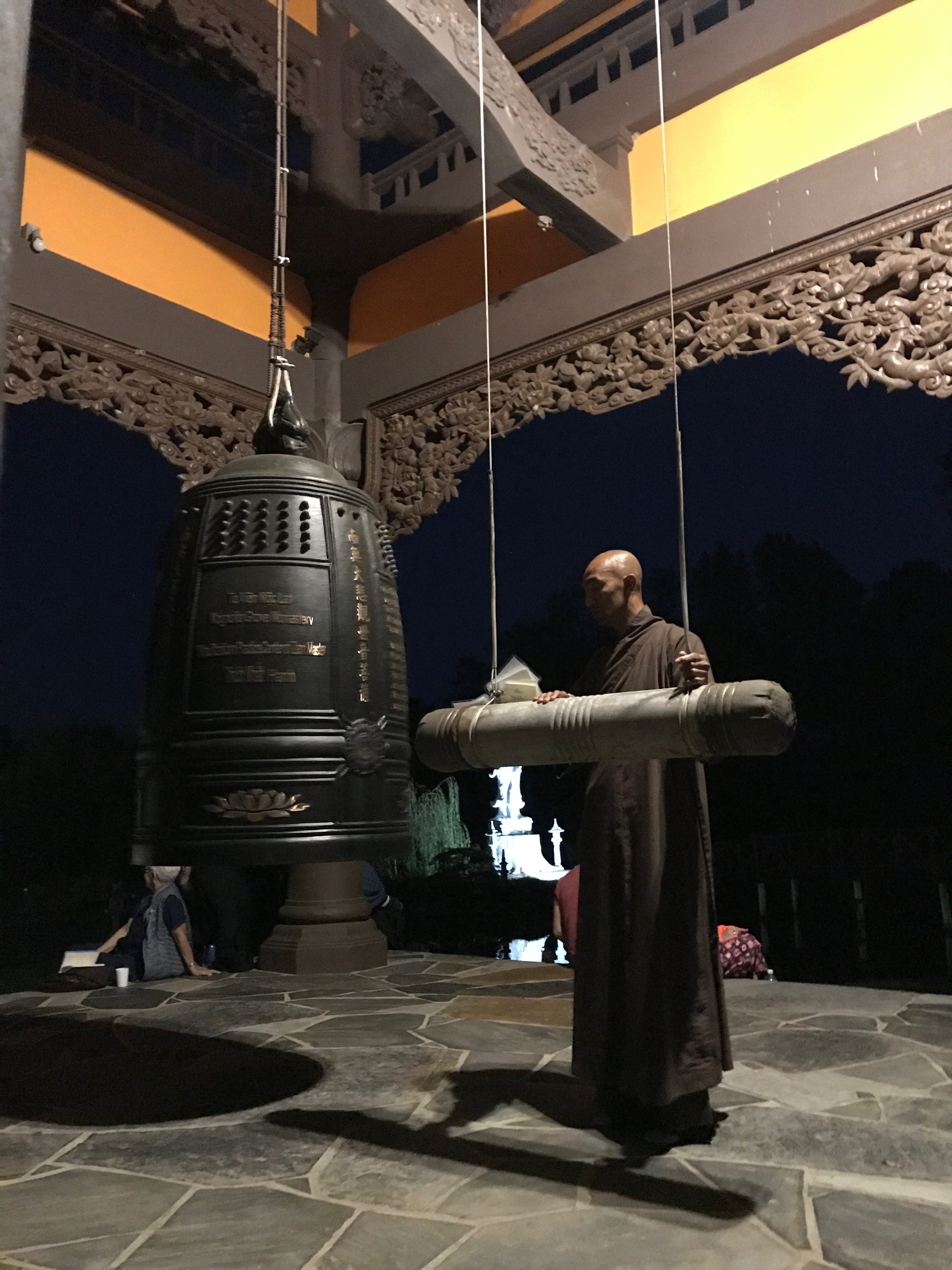
I’ve had the profound honor of walking in silence with Thich Nhat Hanh through the meadows at his monasteries. When our family was with him at Magnolia Grove Monastery in Mississippi, he took my daughter Ava Grace’s hand and taught her to walk mindfully, feet kissing the earth with each step.
This practice, taught in his book Peace is Every Step, invites us to experience each step as a homecoming.
“The present moment is filled with joy and happiness.
If you are attentive, you will see it.” — Thich Nhat Hanh
Let your movement be your meditation. Let the Earth carry you back to yourself.
4. Schedule Your Pauses
A key for me over the years is to calendar moments to pause, to breathe, to move, to reset. This was done for me when I lived in Hannover, Germany, directly across from a beautiful old church with a stunning mosaic from Ravenna. Each day, the tower bells ring at 9 am, noon, 3 pm and 6 pm. My neighbor Friedrich, a spiritual teacher, taught me pause and breathe each time I heard the bells. When I returned to the US, I built this into my schedule. Experiment integrating two short pauses into your day, or you may choose the tower bell times in your own day.
Label them in your digital calendar with names like:
Rest Here Now
Sacred Pause
Dear One You Are Loved
Just One Breath
Pause + Check-in
Pausing for bells is a core practice built into time spent over the years at Thich Nhat Hanh’s monasteries. A nun or monk will “invite the bell” at dawn and then at random times during the day, and when we heard the deep, resonate sound everyone on the monastery would stop just where they are, not moving, and take a breath. It was powerful.
Let your own reminders ring like temple bells in your day, calling you home again.
The Peace of Wild Things
by Wendell Berry
When despair for the world grows in me
and I wake in the night at the least sound
in fear of what my life and my children's lives may be,
I go and lie down where the wood drake
rests in his beauty on the water, and the great heron feeds.
I come into the peace of wild things
who do not tax their lives with forethought
of grief. I come into the presence of still water.
And I feel above me the day-blind stars
waiting with their light. For a time
I rest in the grace of the world, and am free.
An Invitation
Where will you pause today?
Will you take one breath with presence?
Stand for a moment with your hand over your heart?
Walk slowly through the trees or by the sea?
Sit at your altar with a candle and a prayer?
There is a deeper rhythm inside you—slower, wiser, more generous.
Let it guide you back to the field that is already, always there.
And as David Whyte so simply, so beautifully reminds us:
“Everything is waiting for you.”
Great insights for peace. You are a gifted writer.❤️
You write so beautifully and vividly. Reading this script was my pause. Thank you.